


What you need to know about saving for retirement.
Retirement planning for women… what a weird concept, right?
You worked your whole life…so that you can kick back and enjoy those ‘golden years.' You have a list of ALL of the things you want to do. You want to buy an RV and travel. See the grandkids more often. Work in the garden. Sleep in. NEVER get on a plane again. Take up a new hobby or find time to do the hobbies that you love. ALL THE THINGS.
But what about the money part of the equation? Did you save enough money for your retirement?
Unfortunately most people underestimate what they really need to live on when they are no longer working. Especially women. Women live longer than men…and sometimes the money runs out and they are stuck living below the poverty level.
Don't let that happen to you!
Depending on how old you are when reading this will depend on what you need to do to save.

If we haven’t met, hi, I’m Jane.
I’m a financial coach and creator of Financial Independence Society. Years ago, I hit my own financial wall — no savings, no retirement plan, and a lot of stress behind the scenes.
So I created a clear, intentional money plan that helped us build real financial security.
Now I teach women how to build financial freedom with calm, confident decisions, especially when it comes to retirement planning and long-term wealth.
Because financial freedom isn’t something you chase… it’s something you build.
The earlier in your life that you can begin saving for retirement the better

Compounding interest is a wonderful thing. If, at age 23, you save $500/month, at an average rate of 10% (stock market average over 100 years is 10%), you will have at age 60…$3.8mm. That is millions!
If you start at age 35, and save $500/month, at the average rate of 10%, you will have $1.1mm. The difference is $2.7mm!!
Something to think about, right?
All that to say… saving for retirement is HUGE.
Start now…regardless of your age.
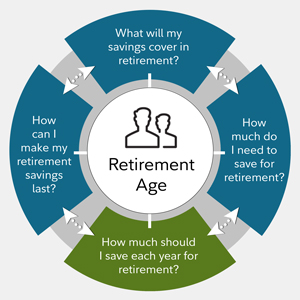
How much should you save for retirement?
This is a loaded question….because there are SO many factors involved in the answer.
The general rule of thumb is to save 15% of your GROSS (before tax) income. This includes your IRA's, 401K's, and other employer savings plans. If you make $50,000 a year, you need to save $7500. If you make $200,000 a year, you need to save $30,000.
But FIRST…
A few things to be done first:
- Emergency fund funded – 6 months of money needs to be set aside in an emergency fund. This is money that you will use in case of an emergency. Someone lost their job or got sick and can no longer work. This is NOT money you tap into when you need a new roof or refrigerator. That is a totally different fund – called your Repair Fund.
- Debt is being addressed and paid off quickly – Do NOT just pay the minimums. At that rate you are hardly touching the principal and just paying interest. It will take you 20 years to pay off that debt. Curtail spending in one area so that you can pay off that debt quickly
Once you have addressed the above 2 items it is time to save for retirement!
What happens if you are older…how do you begin saving for retirement then?
Back when I was in my late 40's I was reading a book about finances. I think it was Dave Ramsey's ‘Total Money Makeover.' I remember sitting on the sofa and crying. I did NOT want to live in government funded housing and be a greeter at a discount store. (NOT that there's anything wrong with that…it is just what I did not want to have to do).
We lived in a nice house. Had 2 cars. My husband made a good income. But, we had NO savings. None. Like in NONE. Not even retirement.
When my husband came home I told him that we were going to make some drastic spending changes so that we had savings…and we did.
I cut back on everything. Sold what we no longer used or needed. Paid cash for everything. Shopped discounts….until I stopped shopping altogether. Maxed out our 401K. Why?
I wanted to be saving for our retirement!
I knew we did not have many years left to save. We were 20 years too late when it came to all of that compounding interest. But we could save something.
I knew we might have to sell our house and get a smaller, less expensive one. And that was ok with me. I just wanted to know that we were not eating rice and beans for every meal. And, I did not want to be a burden to my kids.
I would like to encourage you to ask yourself the hard questions. I mean the really hard questions.
- Where do I want to live when you retire?
- What lifestyle do I want to have?
- How much money do I want to have…really?
- Can I cut back now so that I have money later?
- How will I be able to save all that I need for later?
- What happens if my spouse dies before me? Will I have money? Do we have life insurance?
- How will I pay for home care if I get sick and need help?
Once you know the answers to the above questions you will have a handle on what you need to do. And then count backwards. Meaning…
Let's say you are 40 and you want to begin saving for retirement now.
You have 25 years until you retire. Figure out:
- How much will you receive in Social Security? Figure out the NET (yes, you pay taxes on your SS income)
- What are your monthly expenses now? What will those expenses be when you are retired (estimated of course).
- What is the difference? Income – Expenses = Money leftover.
- Negative number….that is how much you need every month to be able to maintain the lifestyle that you currently have.
- Do the math. Multiply the negative number x 12. Multiply that times the average years to live. Right now it's 81 for a woman. In 2060 they expect it to be 87.
So here is the math.
You receive $2500 a month in NET Social Security income. Your expenses are $3500 a month.
You are short $1000 a month.
$1000 x 12 = $12,000 (yearly deficit)
$12,000 x 16 (average age is 81 and you are 65 when you retire – so 16 years) = $192,000 SHORT.
At age 40…retire at age 65. You have 25 years to save. Assuming NO interest. You need to save $7680 a year in order to cover your deficit from above.
And, if your deficit is larger…you need to save more money every year.
If you take that same $7600 and invest it. Average 7%. You will have over $500,000!
Here is the Positively Jane Retirement Calculator. Plug in numbers…see where they take you.
BTW – NONE of the above takes inflation into consideration (3% average).
As you can see…the sooner you start saving for retirement the better!
Don't wait! Once you wrap your head around the fact that you WILL get older (hopefully). And that it is up to YOU to take care of yourself when you retire. It gets a tad easier to cut back now so that you have something when you are older.
My mom had a stroke at age 87. She had money in the bank…so we are able to pay for her caregivers with that money and she lives at home. Otherwise she would be living in a state funded nursing home…with no visitation due to Covid.
As with most things…it comes down to choices. It is ALL up to you.
FAQs
Retirement planning is especially important for women because women tend to live longer than men and often earn less over their lifetime. That means your savings may need to stretch further. Building financial security for women requires intentional planning so you’re not dependent on Social Security alone. The earlier you start, the more confident and secure your future can feel.
There isn’t one “magic number” that works for everyone. The right amount depends on your lifestyle, health, retirement age, and long-term goals. True financial freedom for women comes from knowing your personal “real number” — not guessing. A clear, calm retirement plan helps you determine what you actually need so you can save with confidence instead of fear.
The best time to start saving for retirement is as early as possible. Even small contributions in your 20s or 30s can grow significantly over time thanks to compound growth. But it’s never too late to begin. Financial security for women is built step by step — with clarity, consistency, and a plan that fits your real life.
Financial security means you have enough saved to cover your needs without stress. Financial freedom for women goes a step further — it’s having choices. It’s being able to travel, give generously, help family, or simply sleep peacefully knowing your money supports your life. Retirement should feel calm and confident — not uncertain or restrictive.
A few more posts for you to read about Personal Finance:

Find your security...and live life on YOUR terms.
Create financial freedom through clarity, not stricter budgets.

WATCH FREE MASTERCLASS